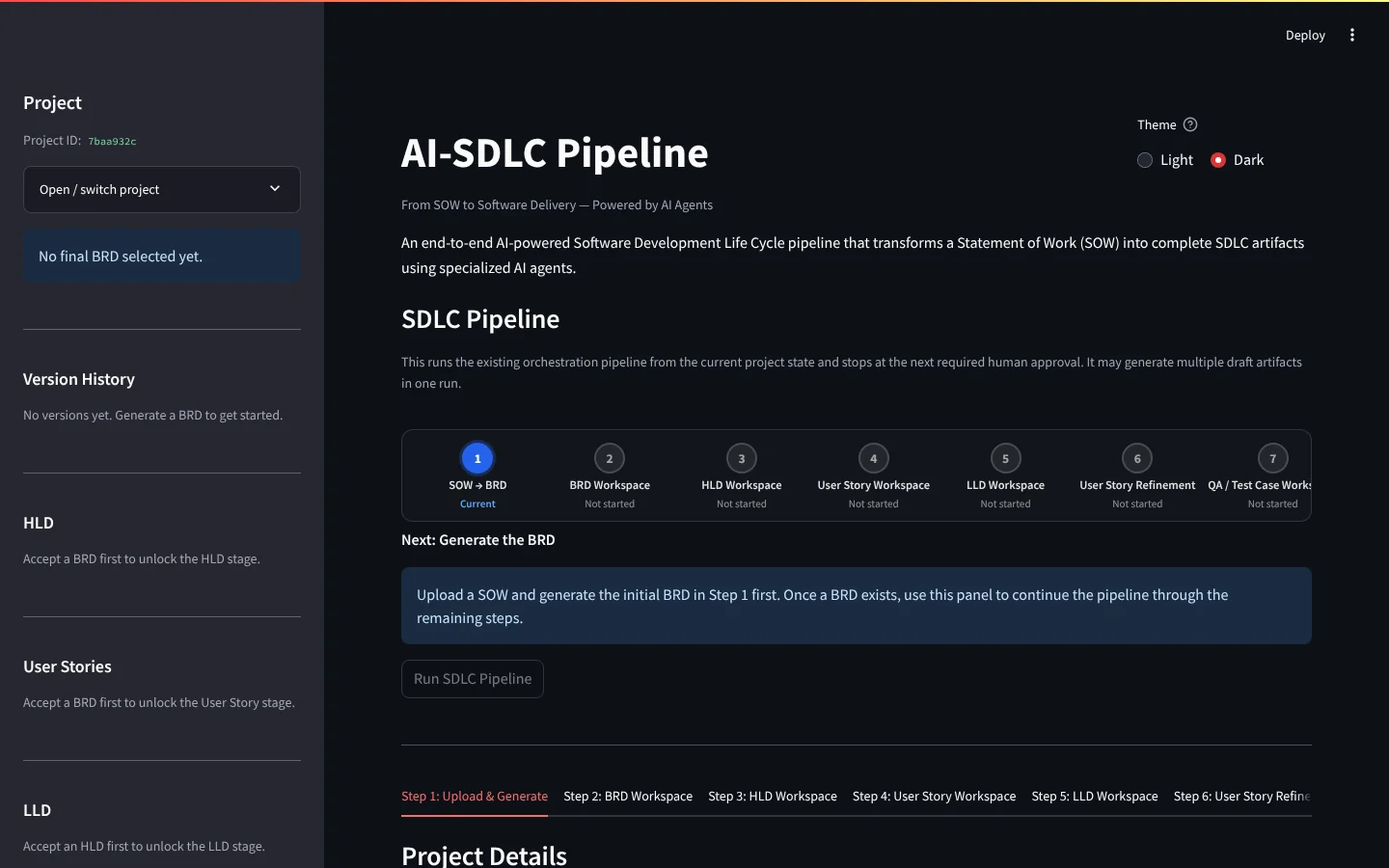
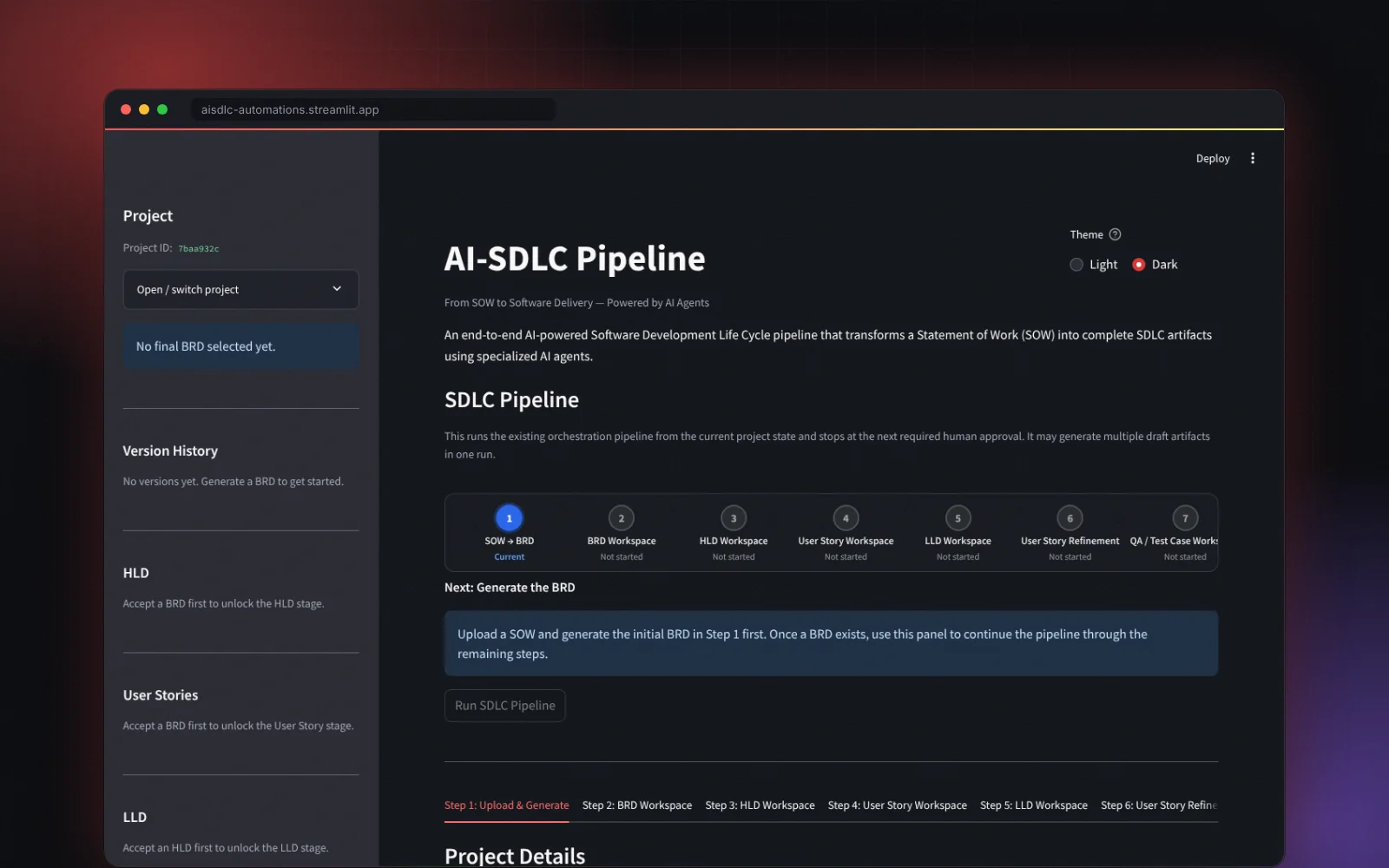
AI-SDLC Pipeline
From a Statement of Work to software delivery, with AI agents
Turning a Statement of Work into delivery documents takes weeks, and the documents drift out of sync.
Seven AI agents, one per SDLC stage, with a human approving each stage.
BRD to closure report in one versioned, traceable pipeline with Word export.
- Role
- Agent design and development
- Year
- 2026
- Stack
- Python, Streamlit, LangChain, Gemini, Pydantic, python-docx, pytest, Docker
Overview
A pipeline of seven specialised AI agents that turns an uploaded Statement of Work into a full set of software delivery documents, with a human approving every stage.
The problem
Turning a client's Statement of Work into requirements, designs, user stories and test cases takes weeks of analyst and architect time, and the documents drift out of sync as soon as one of them changes.
What I built
- 1Built seven agents, one stage at a time: Business Analyst (BRD), Solution Architect (HLD), User Stories, Low-Level Design, Story Refinement, QA test cases and a Closure Report.
- 2Gave every stage the same lifecycle: manual editing, AI-assisted refinement, full version history, locking a final version and Word export.
- 3Tracked provenance: each document records the exact source versions it was built from and is flagged stale, never silently changed, when a source changes.
- 4Kept decisions that must be exact out of the model: the closure status is deterministic and the agent never finalises its own work.
Highlights
- Human-in-the-loop by design: no stage advances without an accepted document.
- Plain JSON persistence, no database, no RAG: simple and auditable.
- 782 automated tests across 49 test files.
How it works
- Statement of Work
- BA agent → BRD
- Architect agent → HLD
- User Story agent
- LLD agent
- QA agent → test cases
- Closure report
Key decisions and trade-offs
No database, no RAG
Plain JSON persistence with full version history keeps the system simple to run and easy to audit.
Humans approve every stage
Agents draft; nothing moves to the next stage until a person accepts the document.
Flag stale, never silently change
When a source document changes, documents built from it are marked stale instead of being regenerated behind the user's back.
Rules decide, the model writes
The closure status is computed deterministically; the language model only writes the narrative.
Screens